

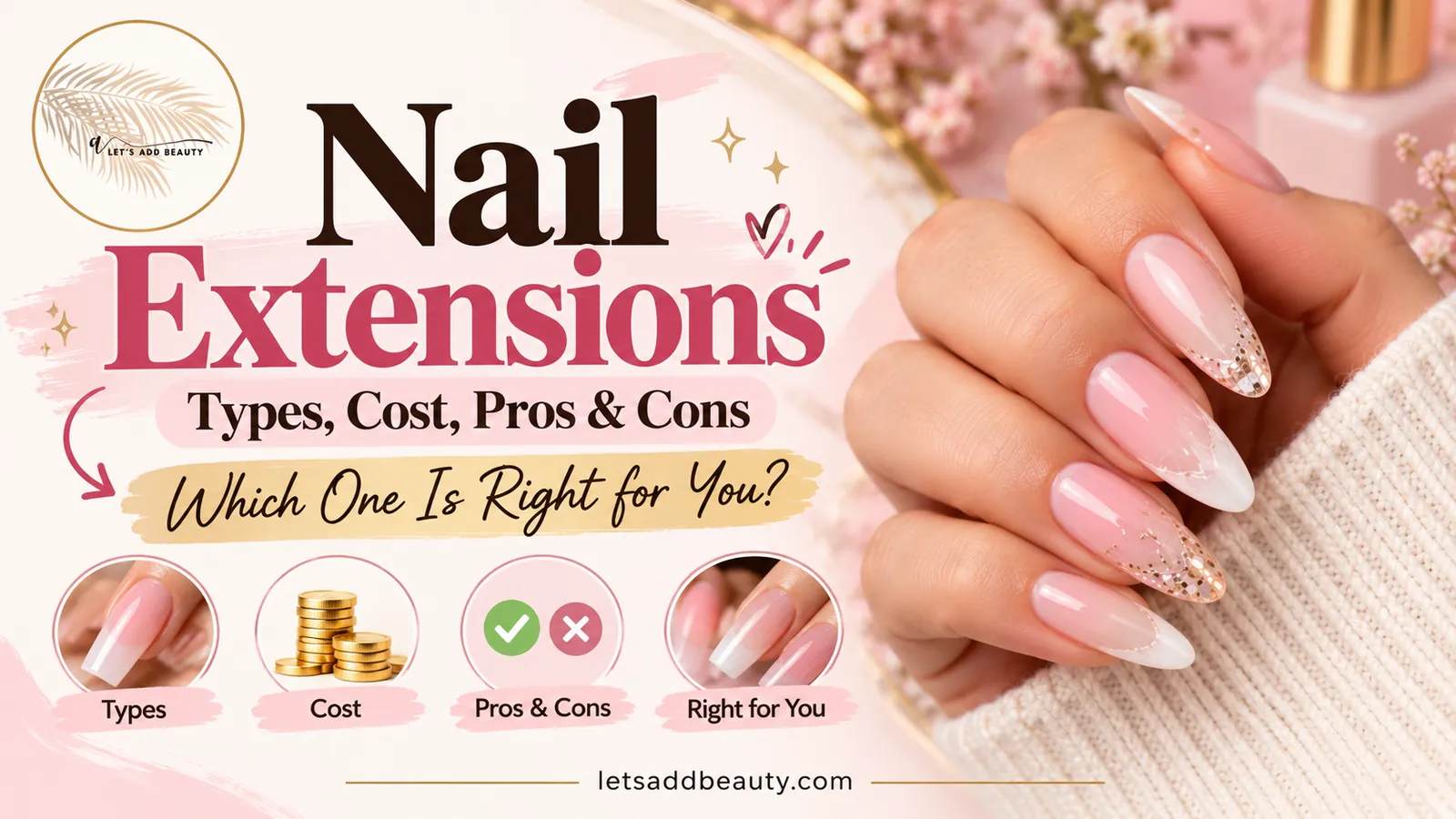
If you’re thinking about getting nail extensions for the first time, choosing between gel, acrylic, polygel and other options can feel surprisingly confusing. The price can vary too, and the cheapest option is not always the best choice for your nails or lifestyle.
The good news: you don’t have to choose an extension type simply because it looks pretty in a salon photo. The right option depends on how much length you want, how much strength you need, how often you are willing to maintain them, your budget, and how your natural nails are doing.
In this guide, we’ll break down the different types of nail extensions, their typical cost in India, pros and cons, how long they last, maintenance, removal and possible damage—so you can decide which option makes sense for you.
“Before getting extensions, it’s worth making sure your natural nails are in good condition. Our beginner’s guide to nail care covers the everyday habits that can help you maintain healthier-looking nails.”
LETSADDBEAUTY
📖 In This Guide
✨ What Are the Different Types of Nail Extensions?
💰 Nail Extension Cost in India: How Much Should You Expect to Pay?
⚖️ Gel vs Acrylic vs Polygel: Which Is Better?
➕ Pros and Cons of Nail Extensions
🛡️ Do Nail Extensions Damage Your Natural Nails?
⏳ How Long Do Nail Extensions Last?
🌿 Nail Extension Maintenance and Aftercare
🧴 How to Remove Nail Extensions Safely
💗 Which Nail Extensions Should You Choose?
🔎 What to Check Before Getting Nail Extensions at a Salon
❓ Frequently Asked Questions About Nail Extensions
💅 What Are Nail Extensions?
Nail extensions are artificial enhancements added to your natural nails to create extra length and shape. Depending on the system used, the extension may be made with acrylic, gel, polygel, soft-gel tips or another material.
Unlike regular nail polish or gel polish, which mainly adds colour and shine to your existing nails, an extension system is designed to add length and structure.
That distinction is important because people often use terms such as “gel nails,” “gel extensions” and “gel polish” interchangeably even though they can refer to different services.
| Service | Adds Length? | Main Purpose |
|---|---|---|
| Regular manicure | No | Clean, shape and care for natural nails |
| Gel polish | No | Longer-lasting colour on natural nails |
| Nail overlay | Usually no | Add strength or structure to natural nails |
| Nail extensions | Yes | Add length, shape and structure |
| Press-on nails | Yes | Temporary length and style |
So if your goal is simply to make your natural nails stronger without significantly increasing their length, an overlay may be more appropriate than a full extension set.
If you are new to nail care, it is also worth understanding how to prepare and look after your natural nails before adding enhancements. You can refer to our Nail Care Guide for the basics of everyday nail care and maintenance.
✨ What Are the Different Types of Nail Extensions?
There is no single “best” nail extension type. Acrylic, gel and polygel all behave differently, and the right choice depends on the length, flexibility, finish and maintenance you want.
1. Acrylic Nail Extensions
Acrylic extensions are created by combining a liquid monomer with acrylic powder to form a workable material that is shaped over the nail or an extension form/tip.
Once cured, acrylic creates a hard and durable structure, which is one reason it remains popular for longer and more dramatic nail shapes.

Best for: people who want strong, structured extensions or significant length.
- Strong and durable
- Good for long or sculpted shapes
- Widely available in salons
- Usually one of the more affordable professional extension options
- Requires careful filing and professional removal
2. Gel Nail Extensions
Gel extensions use a gel product that is cured under a UV or LED lamp. Depending on the technique, the technician may use a tip, form or sculpting gel to create the additional length.
Gel extensions are popular with people who prefer a lighter, glossy and more natural-looking finish.
Best for: people who want a natural-looking extension with a lighter feel.
- Natural-looking finish
- Usually lighter and more flexible than traditional acrylic
- Glossy appearance
- Available in different systems and lengths
- Requires proper curing and professional application
Important: gel polish is not the same thing as gel extensions. Gel polish is applied to your existing nail, while gel extensions are designed to create additional length.
3. Polygel Nail Extensions
Polygel is often described as a hybrid-style system because it combines characteristics associated with acrylic and gel systems. It is applied as a thicker product that can be shaped before being cured under a lamp.
For someone who wants a balance between structure and a lighter feel, polygel can be worth considering.

Best for: people who want a compromise between acrylic-like strength and a gel-like feel.
- Can provide good strength without feeling as heavy as some acrylic sets
- Highly shapeable during application
- Suitable for different lengths and shapes
- Often positioned as a middle-ground option
- Usually more expensive than basic acrylic services
4. Soft Gel Tips
Soft gel tips are pre-shaped gel tips that cover the natural nail and are cured into place with a suitable gel adhesive or system.

They can be particularly appealing if you want a relatively quick application and a uniform shape.
Best for: people who prefer lightweight, pre-shaped extensions and a natural finish.
5. Fiberglass or Silk Extensions
Fiberglass and silk systems use woven material combined with resin or adhesive to create reinforcement or extension. They are less commonly discussed than acrylic and gel systems, but some technicians use them for repairs or more specialised applications.

Best for: specific nail-repair or reinforcement needs when an experienced technician recommends the system.
6. Dip Powder
Dip powder is often included in lists of nail enhancement types, but it is important to understand the distinction: dip powder is generally a coating system rather than a traditional length extension by itself.

It can add strength and colour to the natural nail, but it should not automatically be treated as equivalent to a sculpted acrylic, gel or polygel extension.
7. Press-On Nails
Press-on nails are a useful temporary alternative if you want the appearance of longer nails without committing to a salon extension system.

They can be especially useful for occasions, travel or anyone who does not want regular refill appointments.
However, their wear time depends heavily on the quality of the nails, preparation, adhesive and how you use your hands.
💰 Nail Extension Cost in India: How Much Should You Expect to Pay?
The cost of nail extensions in India varies considerably. There is no single national price because the final amount depends on the extension system, salon, city, technician experience, length, shape and nail art.
Current Indian pricing guides published in 2026 show broad full-set ranges from roughly ₹1,200 to ₹4,500, with premium or highly decorated sets potentially costing more. Acrylic generally sits toward the lower end, while polygel and more elaborate services can cost more.
Use the figures below as a budgeting guide rather than a fixed national price list.
| Extension Type / Service | Indicative Price Range in India |
|---|---|
| Acrylic extensions | ₹1,200–₹2,500+ |
| Gel extensions | ₹1,800–₹3,500+ |
| Polygel extensions | ₹2,500–₹4,500+ |
| Refill / infill | ₹800–₹1,800+ |
| Extension removal | ₹400–₹900+ |
| Simple nail art | Often charged separately |
| Detailed / designer nail art | Can add substantially to the final bill |
Published salon pricing in Hyderabad, for example, can differ noticeably depending on the salon and system. One current Hyderabad guide lists gel extensions around ₹2,200–₹4,000, acrylic around ₹2,000–₹3,500 and polygel around ₹2,500–₹4,000.
♦ Why Do Nail Extension Prices Vary So Much?
When comparing salon prices, don’t look only at the starting price. Ask what is actually included.
- Extension type: Acrylic, gel and polygel can have different costs.
- Length: Very long extensions usually require more product and application time.
- Shape: Coffin, stiletto and other sculpted shapes may require additional work.
- Nail art: Chrome, French tips, ombré, crystals and hand-painted designs can cost extra.
- Technician experience: Skilled nail technicians may charge more.
- Salon location: Prices tend to be higher in premium areas and major metropolitan markets.
- Product system: Professional products and specialised systems can affect the price.
- Removal or refill: These may be separate services rather than being included in the initial price.
♦ Don’t Forget the Maintenance Cost
Nail extensions are not usually a one-time beauty expense. As your natural nails grow, a visible gap develops near the cuticle and the structure becomes less balanced.
Depending on the system and your nail growth, salons commonly recommend maintenance or refill appointments roughly every 2–3 weeks, although some sets can be worn longer before needing attention. Current salon guides commonly quote around 2–4 weeks depending on the system and application quality.
That means a ₹2,000 extension set should not be thought of as a ₹2,000 beauty expense if you intend to maintain it for several months. Your realistic budget should include refills, occasional removal and any nail art or repairs.
🆚 Gel vs Acrylic vs Polygel: Which Is Better?
Instead of asking which extension type is universally “best,” it is more useful to ask which one fits your priorities.
| Feature | Gel | Acrylic | Polygel |
|---|---|---|---|
| Look | Natural and glossy | Structured | Natural-looking and sculptable |
| Strength | Good | Very good | Good to very good |
| Flexibility | Generally more flexible | More rigid | Middle ground |
| Best for | Natural-looking styles | Longer, stronger shapes | Balance of strength and weight |
| Maintenance | Regular | Regular | Regular |
| Typical price | Mid-range | Lower to mid-range | Mid to premium |
1. Choose Gel If…
- You prefer a natural-looking finish.
- You don’t need extremely long extensions.
- You prefer a lighter-feeling enhancement.
- You like a glossy salon finish.
2. Choose Acrylic If…
- You want significant length.
- You prefer a very structured nail.
- You want strong sculpted shapes.
- You want a widely available and often more budget-friendly option.
3. Choose Polygel If…
- You want a balance between structure and flexibility.
- You like the idea of a lighter-feeling alternative to traditional acrylic.
- You are comfortable paying somewhat more for the system.
- You have access to a technician experienced with polygel application.
There is no scientifically reliable rule that one material is automatically “damage-free.” The condition of your natural nails depends heavily on preparation, filing, application, curing, maintenance and especially removal.
💖 Pros and Cons of Nail Extensions
Pros of Nail Extensions
- Instant length: You can achieve a length that may take months to grow naturally.
- Custom shapes: Extensions allow you to create shapes that may be difficult with short natural nails.
- Long-lasting appearance: A professionally applied set can maintain its appearance for weeks with proper care.
- More styling options: Extensions provide a larger surface for French tips, chrome, artwork and other designs.
- Useful for special occasions: They can create a polished look for weddings, holidays, events and photos.
Cons of Nail Extensions
- Ongoing maintenance: You need refills or removal as the natural nail grows.
- Higher long-term cost: Regular refills can cost considerably more than a one-time manicure.
- Potential natural nail damage: Aggressive filing, lifting, picking or incorrect removal can weaken the nail.
- Risk of lifting: Poor preparation or application can cause extensions to lift prematurely.
- Time commitment: Application, refills and removal take longer than a basic manicure.
- Not ideal for every nail: If the natural nail or surrounding skin is already irritated or damaged, extensions may not be appropriate.
🛡️ Do Nail Extensions Damage Your Natural Nails?
Nail extensions do not automatically ruin your natural nails. However, the way they are prepared, applied, maintained and removed can make a significant difference.
Potential problems are more likely when the natural nail is excessively filed, an extension is forcibly removed, lifting is ignored, or salon hygiene and application practices are poor.
Dermatology and beauty reporting also highlights problems associated with repeated aggressive filing and improper removal, including thinner or weaker nails. Allergic reactions to acrylate-containing products are another possible concern for some people.
Common Causes of Nail Damage
- Over-filing the natural nail.
- Peeling or pulling off extensions.
- Picking at lifted product.
- Leaving a severely lifted extension attached.
- Using nails as tools to open, scrape or pry objects.
- Applying extensions over nails that are already damaged or infected.
- Poor salon hygiene.
- Improper curing or application.
Do Your Nails Need to “Breathe”?
- You may hear that your nails need to breathe between extension sets. Nails do not breathe in the way lungs do, so the issue is not that an extension is literally preventing oxygen from reaching the nail.
- However, taking a break can be useful if your nails have become thin, sore, peeling or otherwise damaged. The more important step is identifying what caused the damage and avoiding further trauma.
- If you notice persistent pain, significant discoloration, swelling, nail separation or other concerning changes, it is better to stop cosmetic nail services and seek professional medical advice.
⏳ How Long Do Nail Extensions Last?
A professionally applied nail extension set can commonly remain present for around 2–4 weeks, but the exact lifespan varies with the extension system, nail growth, application quality and how you use your hands.
| Factor | How It Affects Longevity |
|---|---|
| Natural nail growth | Creates a visible gap and changes the balance of the extension |
| Application quality | Poor prep can lead to early lifting |
| Nail length | Very long nails can experience more leverage and stress |
| Water and chemicals | Frequent exposure can contribute to lifting or wear |
| Daily habits | Using nails as tools increases the chance of breakage |
| Aftercare | Good care can help maintain the appearance and condition of the set |
Rather than waiting for an extension to become badly grown out or lifted, schedule maintenance according to your technician’s recommendation and the condition of your nails.
🌸 Nail Extension Maintenance and Aftercare
Good aftercare is not just about keeping your extensions looking pretty. It also helps reduce unnecessary stress on the natural nail underneath.
1. Keep Your Cuticles Moisturised
- Regular use of cuticle oil or a suitable moisturising product can help keep the skin around the nails comfortable and conditioned.
2. Don’t Use Your Nails as Tools
- Avoid using extensions to open cans, scrape labels, pry objects or perform tasks that put excessive pressure on the nail.
3. Wear Gloves for Household Cleaning
- Frequent exposure to water and cleaning chemicals can be hard on both your skin and nail enhancements. Wearing gloves during cleaning can reduce exposure.
4. Don’t Pick at Lifting Product
- If an extension begins to lift, don’t pull it off yourself. Picking can remove layers of the natural nail along with the product.
5. Don’t Ignore a Broken or Painful Extension
- A damaged extension can put additional stress on the natural nail. Have it assessed or repaired rather than continuing to wear it if it is painful or significantly damaged.
6. Schedule Refills Before the Set Becomes Too Grown Out
- As your natural nail grows, the extension’s balance changes. Regular maintenance helps keep the set structurally manageable.
If you’re also working on improving the health and appearance of your natural nails, this is a good place to revisit our Nail Care Guide for basic nail-care habits.
🧴 How to Remove Nail Extensions Safely
Never rip, peel or forcibly pull nail extensions off your natural nails.
The safest removal method depends on the specific product used. Some systems can be softened with acetone, while others require controlled filing by a trained professional.
Why DIY Removal Can Be Risky
When you force an extension off, the natural nail layers underneath can come away with it. This can leave the nail thin, rough and more vulnerable to splitting.
Professional removal is particularly worthwhile if you are unsure which system has been used or if the extension has become firmly bonded to the natural nail.
After Removal
- Keep nails comfortably short if they feel weak.
- Moisturise the nails and surrounding skin.
- Avoid aggressive buffing.
- Give damaged nails time to grow out.
- Do not immediately cover painful or visibly damaged nails with another extension set.
💗 Which Nail Extensions Should You Choose?
The right nail extension depends more on your priorities than on trends.
| If You Want… | Consider |
|---|---|
| A natural-looking finish | Gel or soft gel tips |
| Maximum structure and long length | Acrylic |
| A balance between strength and lighter feel | Polygel |
| Temporary length for an event | Press-on nails |
| Strength without much extra length | An appropriate overlay system |
| The lowest initial cost | Often acrylic, depending on the salon |
| Minimal ongoing commitment | Press-ons or natural nails with gel polish |
1. For Beginners
- If this is your first time getting extensions, you don’t necessarily need to start with very long nails. A shorter, practical length can make it easier to adjust to typing, cooking, cleaning and everyday activities.
2. For Very Short or Weak Nails
- Don’t assume that adding the strongest possible extension is the solution. Your technician should assess the condition of your natural nails and recommend a suitable system and length.
3. For Long, Dramatic Nails
- If you want significant length or a highly sculpted shape, discuss acrylic, hard gel or polygel options with an experienced technician. The longer the nail, the more important proper structure and maintenance become.
4. For a One-Time Event
- If you only want long nails for a wedding, party, holiday or photoshoot, press-ons may be worth considering before committing to a recurring salon-extension routine.
🔎 What to Check Before Getting Nail Extensions at a Salon
The salon you choose can be just as important as the extension type.
1. Ask What System They Use
- Don’t hesitate to ask whether the service is acrylic, hard gel, soft gel tips, polygel or another system. A professional technician should be able to explain what they are applying to your nails.
2. Look at More Than Fresh Sets
- Salon portfolios often show extensions immediately after application. If possible, look for examples of how their work looks after a couple of weeks. This can tell you more about application quality and longevity.
3. Check Hygiene Practices
- Tools and work surfaces should be appropriately cleaned and disinfected between clients. Your technician should also avoid practices that unnecessarily damage the natural nail or surrounding skin.
4. Ask About Removal Before You Book
- Knowing how the salon removes the system is important. Ask whether removal involves soaking, controlled filing or another appropriate method for that specific product.
5. Don’t Choose a Salon Only Because It Is Cheapest
- A very low price may be attractive, but extensions are attached directly to your natural nails. Poor preparation or aggressive removal can cost more in the long run if it leaves you with damaged nails.
❓Frequently Asked Questions
Q. Which type of nail extension is best?
A. There is no single best type for everyone. Gel can suit people who prefer a lighter, natural-looking finish, acrylic can be useful for strength and longer shapes, and polygel can offer a middle ground. Your nail condition, desired length, lifestyle and technician’s expertise should all be considered.
Q. How much do nail extensions cost in India?
A. A full set can range broadly from around ₹1,200 to ₹4,500 or more depending on the system, city, salon, length and design. Acrylic is often less expensive than polygel, while premium salons and detailed nail art can push the total considerably higher.
Q. How long do nail extensions last?
A. Many professionally applied sets need attention within roughly 2–4 weeks. Refills may be recommended sooner depending on how quickly your natural nails grow and how much the extensions are being used.
Q. Are gel extensions better than acrylic extensions?
A. Neither is universally better. Gel is often chosen for its natural appearance and lighter feel, while acrylic is popular for strength and sculpted length. The better choice depends on your desired result and the quality of application.
Q. Do nail extensions damage natural nails?
A. They can contribute to nail damage when the natural nail is excessively filed, extensions are picked or forcibly removed, lifting is ignored, or application and removal are poorly performed. Proper technique and maintenance can reduce these risks.
Q. Can I get nail extensions on weak nails?
A. It depends on why the nails are weak and how severe the problem is. If your nails are painful, severely damaged, separating or showing signs of infection, cosmetic extensions should not be used as a way to cover the problem. Have the condition assessed first.
Q. How often should nail extensions be refilled?
A. Many salons recommend a refill around every 2–3 weeks, although the appropriate timing depends on the system, natural nail growth and condition of the set.
Q. Can I remove nail extensions at home?
A. It depends on the product, but forcibly peeling or pulling extensions off at home is not recommended. Some systems can be safely soaked off with the correct procedure, while others require professional filing. When in doubt, have them removed by a trained technician.
Q. Are press-on nails better than extensions?
A. Press-ons can be a better choice if you want temporary length without committing to regular salon appointments. Extensions may be more suitable if you want a longer-lasting, customised result and are comfortable with ongoing maintenance.
Q. Do nail extensions need a break?
A. Your nails do not literally need to “breathe,” but taking a break can be sensible if they have become thin, sore or damaged. The priority is allowing the damaged nail to grow out and avoiding the cause of the damage.
💗 Final Thoughts: Are Nail Extensions Worth It?
Nail extensions can be a great way to add instant length, create a specific shape and enjoy nail art that would be difficult to achieve on short natural nails. But they are not a completely maintenance-free beauty treatment.
Before booking, think beyond the initial price. Consider the extension type, maintenance schedule, refill cost, removal process, salon hygiene and condition of your natural nails.
- If you want a natural-looking result and lighter feel, gel or soft-gel systems may be worth exploring.
- If you want strong, sculpted length, acrylic may make more sense.
- If you want a balance between strength and flexibility, polygel is another option.
- If you only want beautiful long nails occasionally, press-ons may be the simpler choice.
The best nail extension is ultimately the one that fits your nails, lifestyle and maintenance budget—not simply the one that looks best in a salon picture.


